ESSAYS + STORIES
The Faraway Nearby, 2024: “July, 2024. In response to Jamie Ho and Junli Song”
During the first week of May, I ate a plate of mandu that 엄마 made for my husband Greg and me back in January. She was living with us in Brooklyn after 아빠 died. She had frozen a giant tupperware container full of these handmade 만두, filled with 돼지 고기, 파, 당면, 김치, 두부, and love. As soon as the 만두 hit my tongue, my eyes filled with tears, and a flood of grief hit me like a tidal wave. I ate the 만두. I wept and wailed. It was the first time I had eaten 엄마’s food since February. The smell and taste of her food flooded me with memories of eating 만두 together with my parents, at their table, in their home. The smell and taste of her food also flooded me with the searing grief of the reality that we will never be able to eat 만두 together again.
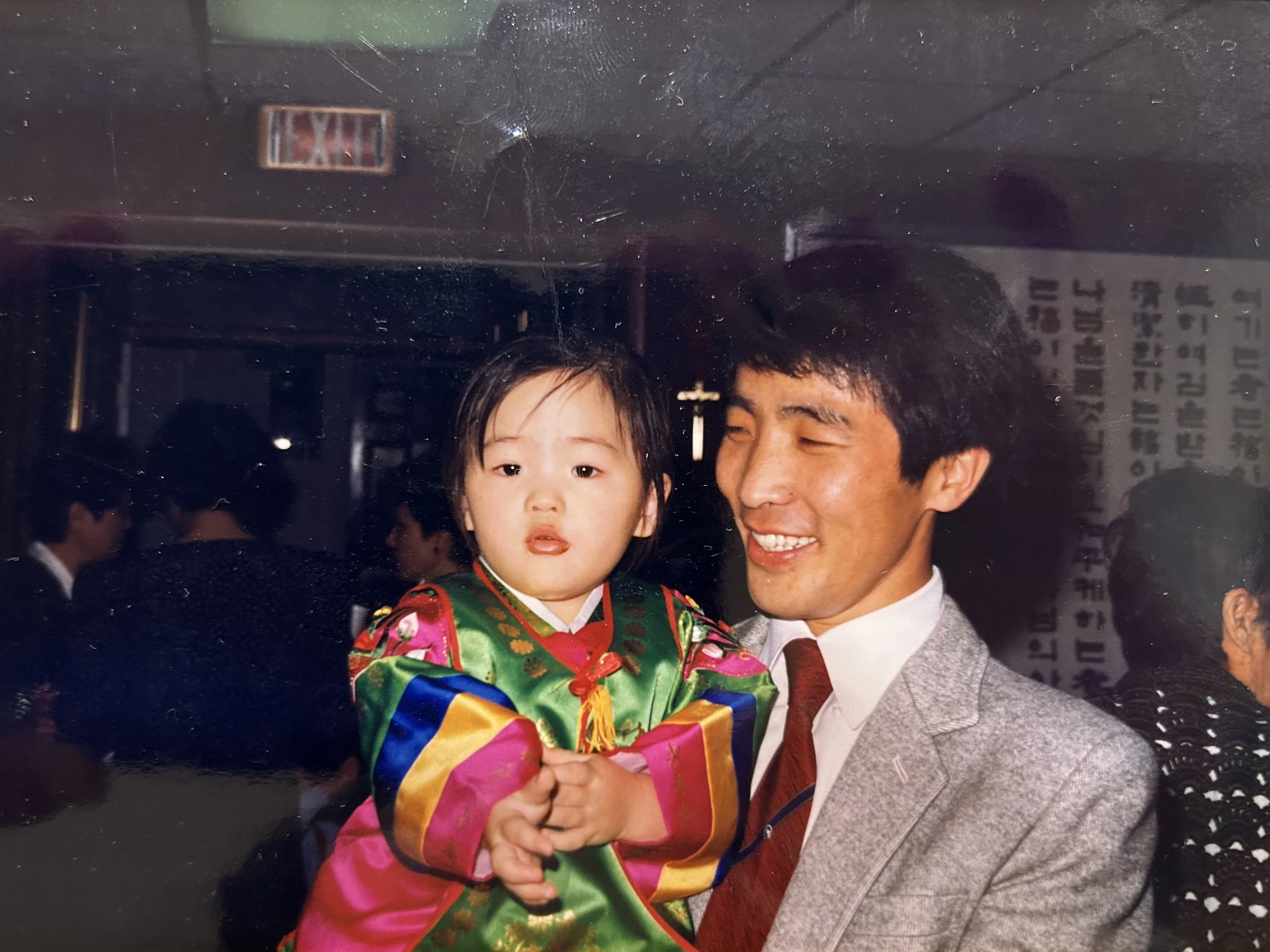
When 아빠 died, it felt like an entire line of my life had suddenly been severed. It felt like all of the lights went out. It felt like losing a limb. It felt like losing a life — my life. It felt like I had lost half of myself. My identity became so unsteady. Who am I without 아빠?
Since 아빠 died, I hold onto things more loosely, and more tightly.
Since 아빠 died, I realized that nothing matters, and everything matters.
Since 아빠 died, physical things feel more meaningless, and more precious.
Since 아빠 died, I live my life with more patience, and more urgency.
The only things we have left when people die are their memories and their things.
I find myself holding onto all of our memories, and all of his things. Read more here.
choa magazine, 2026: “Letters for 아빠”
우리 사랑하는 아빠에게,
어떻게 벌써 일 년이 지났어? 믿기지가 않아. 아빠가 떠나고 나서 앞이 너무 깜깜했지만, 어떻게든 살아왔네.
일 년 동안 아빠가 너무 보고 싶었어. 아빠의 웃음소리. 아빠의 밝은 미소. 아빠의 얼굴. 아빠의 목소리. 아빠의 농담. 아빠의 요리. 아빠가 반겨주던 모습. 아빠가 안아주던 느낌. 아빠의 마음. 아빠의 사랑. 아빠의 전부.
내가 어떻게 일 년을 버텼는지 나도 잘 모르겠어. 아빠가 옆에서 많이 도와준 것 같아. 내가 많이 힘들 때는 힘이 돼줬고, 내가 많이 슬플 때는 웃음을 줬어. 아빠의 몸은 우리 곁에 있을 수 없지만, 아빠의 영혼은 항상 우리와 함께 있다는 걸 알아.
아빠, 나 애 낳았다. 아빠의 첫 손자. 아빠의 하나밖에 없는 딸이 임신해서 엄마가 됐어. 상상이 안 가지? 아빠가 드디어 할아버지가 됐네. 고씨 집안에 식구가 하나 더 늘었네. 이름은 해준이고, 미들 네임은 승현이야. 아빠가 우리 곁에 있었더라면, 해준이를 너무 아끼고 예뻐했을 텐데. 많이 웃게 해 주고, 많이 안아 주고, 사랑도 많이 줬을 거야. Read more here.
Rootkeepers, 2026: “중2 생리팬티•8th Grade Period Underwear”
My 할머니, my halmoni, my grandmother, my mother’s mother. Her name was 정복순, Jung Bok Soon. She was born on May 15, 1932, and she died on February 24, 2019. We lived worlds apart, separated by time, space, continents, and oceans. For 29 years of our lives, we were separated by the displacement of immigration. To me, she was always more dream than reality, more idea than human, more story than memory.
In 2001, when I was 12 years old, during the summer between seventh and eighth grade, I visited Korea for the first time since I had left the country in 1990. I stayed with my grandparents for a few days, and while I was there, I got my period. I was fairly new to having a period and I felt embarrassed, so I shoved my bloodied underwear in the front pocket of my suitcase. I planned on dealing with them later. Read more here.
Rootkeepers, 2026: “우리 엄마는 우리 손에 물 한방울도 묻지 않게 해줬어. Our mother never let one drop of water touch our hands.”
My 할머니 had two daughters. My 이모 (imo, aunt), born in 1956, and my 엄마 (umma, mom), born in 1961. Growing up, 엄마 would always tell me, with tears in her eyes, “우리 엄마는 우리 손에 물 한방울도 묻지 않게 해줬어. Our mother never let one drop of water touch our hands.” 할머니 never let one drop of water touch her daughters’ hands.
For all the years her daughters lived at home, 할머니 cooked every meal, she washed every dish, and she washed every piece of clothing for them. She knew that when her daughters got married, they would have to do all the cooking and cleaning for new families. These were the heavy burdens of women born in 1932, 1956, and 1961. Read more here.